How healthcare professionals are using social media: key statistics and insights for pharma marketers

Oct 15
Social media has become an essential tool for healthcare professionals (HCPs), not just for personal use but for professional learning, peer collaboration, and patient interactions. For pharma marketers, understanding how HCPs engage on digital platforms is critical for running effective campaigns. 

Our Social Media Strategy & Planning course includes a section dedicated to how HCPs are using social media. To give you a taste of our course content, we've included below some key statistics on HCP social media behaviour, insights for pharma marketers, and actionable strategies to boost HCP engagement, deliver credible content, and support medical education through digital channels. PLUS - at the end, there's a freebie download (with all these stats and more) to take with you. 

Key Takeaways 

2/3 of HCPs report using social media for professional purposes
92% of HCPs are open to learning about new drugs or medical devices via social platforms
85% of HCPs reported
that patients have mentioned social media posts during clinical visits

Digital is key for HCPs

The use of digital channels is a key part of the daily lives of healthcare professionals. A recent survey conducted by Sermo1 found that, on average, HCPs check social platforms at least 3 times a day and spend up to 2 hours throughout the day.

Social media is used by many HCPs for personal reasons, but 2/3 of clinicians also reported using it for professional reasons2. This includes both HCP-only sites, like Sermo, as well as public platforms.

Insights

Two-thirds of HCPs use social media for professional purposes, highlighting that these channels are not just for personal scrolling, they are actively seeking credible, relevant content. Frequent daily use means there are multiple touchpoints throughout the day to engage HCPs, particularly during short breaks or in-between tasks. 

Actions

  • Consider professional networks such as LinkedIn, BlueSky, Threads and verified HCP communities, where HCPs actively seek industry-related content as part of your channel planning. These platforms can offer a lower-cost way to reach HCPs compared to traditional channels and can reinforce your broader messaging with a touchpoint they access regularly.
  • Keep in mind what makes good social content for HCPs: focus on what they want from pharma, such as educational videos, real-world evidence, patient case studies, CME opportunities, diagnostic support, and insights from medical congresses. 
  • Social media is a great channel to test and learn what works best for engaging your audience. Plan a suite of assets to test, and keep a central record of the outcomes. HCP audiences on social media are often small, so assets can quickly reach fatigue. Having a bank of content to rotate helps manage this. See other tips for managing a small paid media audience here.

Social media rises as a key channel for HCP education, while face-to-face rep visits decline

Medical education is one of the primary reasons HCPs turn to social media. In fact, a recent survey by So What? found that 95% of doctors using social media professionally do so for educational purposes3.
This aligns with findings from MedFluencers, who reported that 92% of HCPs are open to learning about new drugs or medical devices via social platforms4. By contrast, more than half of those surveyed said they prefer to avoid face-to-face visits from sales reps, and nearly 40% skip traditional lectures for their ongoing education. 

Insights

Social media has become a trusted channel for professional learning: nearly all HCPs using it professionally seek educational content. HCPs are increasingly open to learning about new drugs and medical devices online, showing a shift away from traditional face-to-face sales interactions and in-person lectures.

This trend highlights an opportunity for marketers to provide value through informative, credible content that supports clinicians’ ongoing education.

Actions

  • Social media is an effective way to reach clinicians with medical education initiatives. If you're in a market where you can't discuss medicines on social media, use a targeted paid strategy to reach HCPs and generate interest with an unbranded message, then direct them to a website where they can learn more (see the example below). Once on your website, you can verify the clinician so that medical education can extend into treatment-based topics.
  • HCPs are time-poor, so consider how to make your medical education efforts bite-sized and easy to consume on the go. Think podcast episodes, mobile-friendly formats, and short, digestible learning modules.
  • Focus on making your content stand out in the social media newsfeed. Research shows you have just three seconds to capture someone’s attention before they scroll past, so that first impression is vital. Get to the point quickly: lead with a strong hook that piques interest, and then circle back to provide the details. This strategy mirrors the "emerging story arc" concept, which, though it originates in a YouTube guide, can be applied to content across all social media platforms to make them engaging.
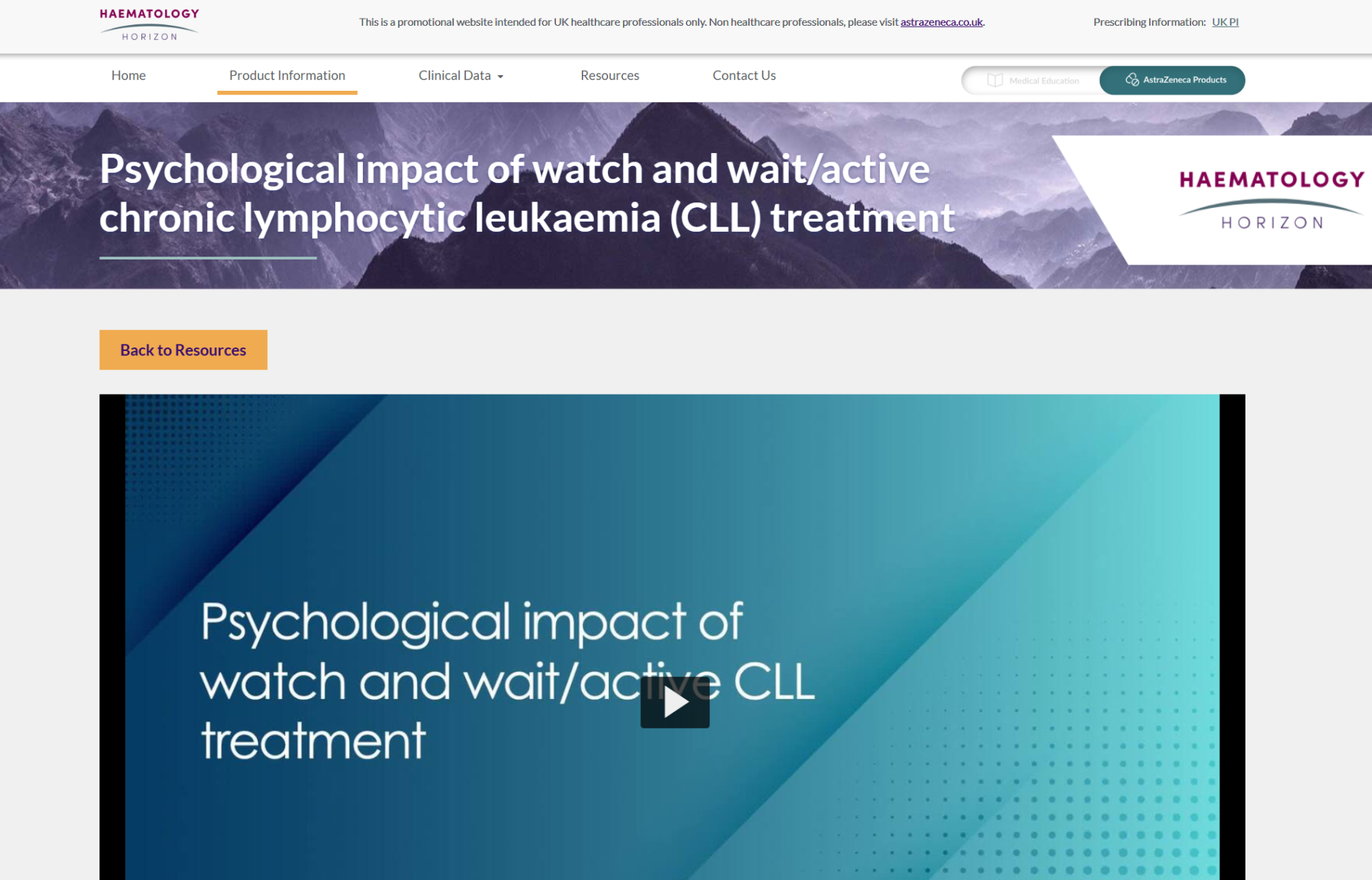
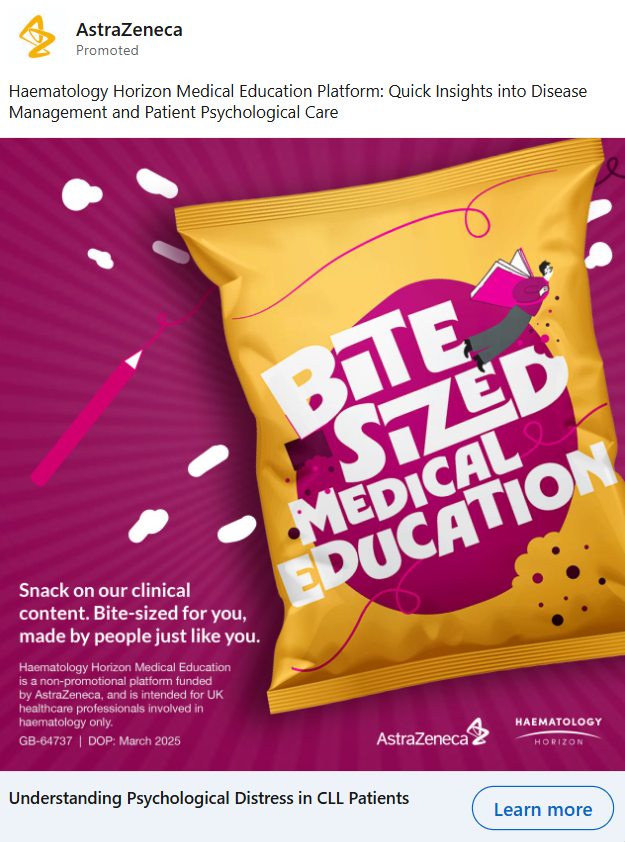
Example: This example illustrates how LinkedIn can be utilised to promote medical education initiatives using eye-catching creative. It appeals to time-poor HCPs by offering educational content they can access quickly.
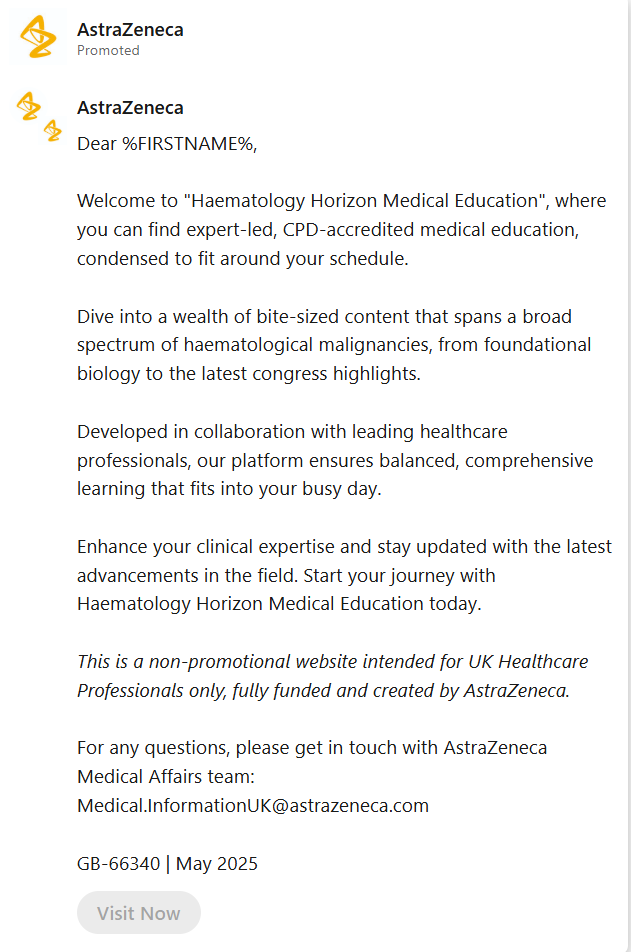
AstraZeneca have used a variety of formats to engage HCPs. Below is an example of a sponsored InMail, which appears directly in an HCP’s LinkedIn inbox, with the FIRSTNAME field dynamically personalised.

Patients are bringing social media in to the clinic

A recent survey by MedFluencers of HCPs across 15 specialties revealed that 85% of HCPs reported that patients have mentioned social media posts during clinical visits4.

Insights

Social media isn’t just a professional tool for HCPs, it’s influencing patient interactions in real-world clinical settings, learn more on patient social media usage here. Patients are increasingly bringing what they see online into consultations, which makes HCPs more aware of trends, opinions, and patient concerns.

This also signals a shift in patient expectations: they are more informed and proactive, and HCPs need to be prepared to discuss topics that may not have been part of traditional education.

HCPs may feel pressure to respond accurately and quickly to patient questions influenced by social media, making it critical for pharma to provide resources that support these conversations.

Actions

  • When running a direct-to-patient campaign, make sure HCPs are aware of the messages being shared with the patient community, even if unbranded. This ensures they are prepared for patient discussions. Launching HCP-focused activity first lays the foundation for more effective patient-HCP conversations..
  • Consider offering clinical tools, educational resources or discussion guides to help HCPs address common patient questions. Social listening, including analysing what patients are searching for on Google or ChatGPT, can inform these materials and give HCPs valuable insight into the questions patients may be asking outside the clinic.
  • Consider collaborating with HCPs to co-create content that anticipates patient concerns, creating alignment between DTC campaigns and clinical guidance.
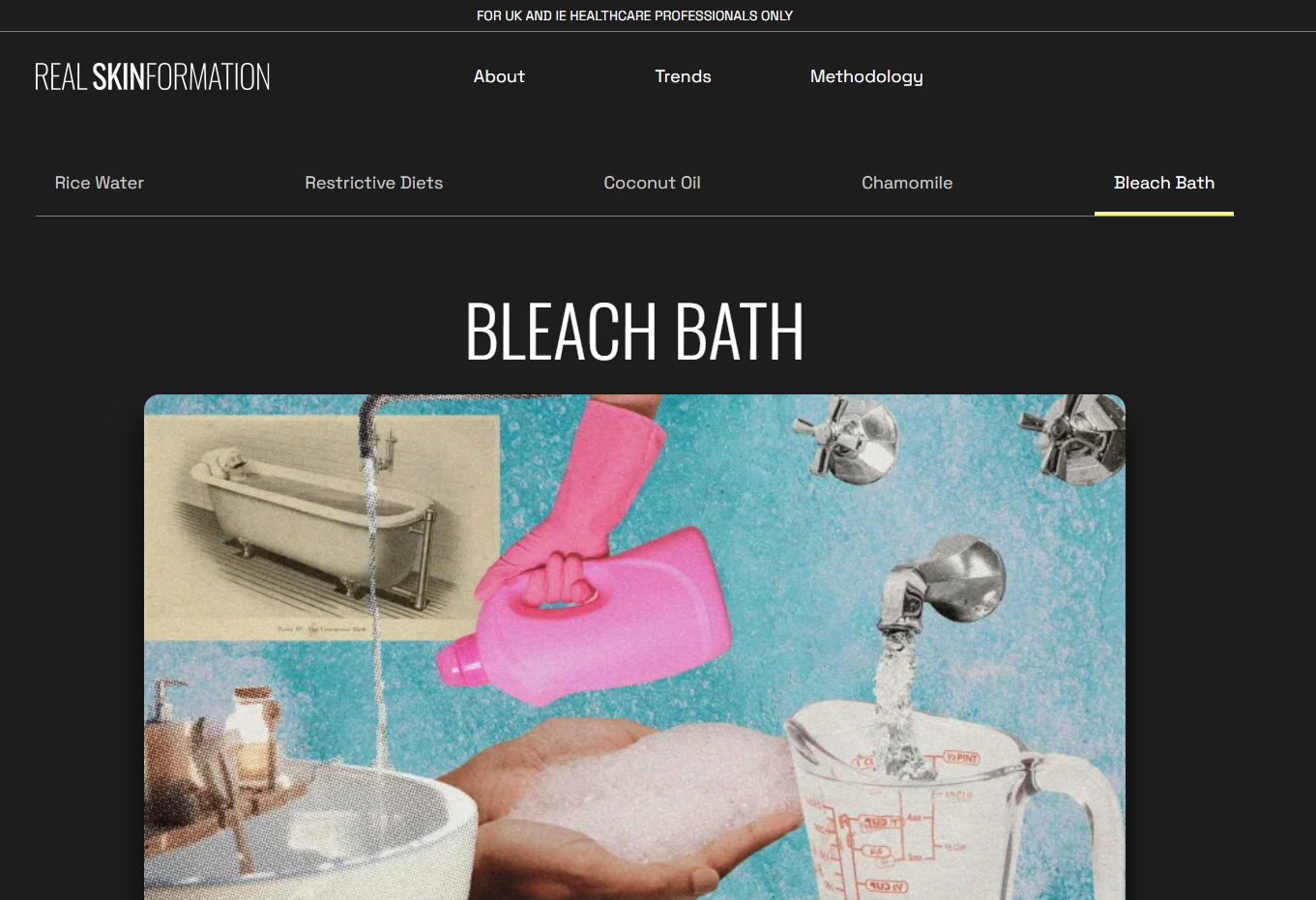
Example: Sanofi UK ran a LinkedIn campaign to help HCPs stay ahead of digital trends shaping how patients manage skin conditions. By sharing insights from online conversations, the campaign helps HCPs to prepare for discussions sparked by content patients see on social media. Check out the website here.
Write your awesome label here.
Below is an example of an HCP-focused campaign from Novo Nordisk, launched across Europe, Asia, and the Americas. The campaign supports HCPs with practical guidance on how to discuss obesity with their patients.
Write your awesome label here.

Get all these stats (and more) to takeaway in your free download

Plus, if you'd like to keep up to date with all the latest stats, downloads, case studies and (of course!) training courses in social media for pharma marketers, sign up for our regular newsletter below.

Select a course to start your learning journey

Created with