Mapping risk in pharma social media campaigns: a step-by-step guide

Apr 17
Risk mapping is useful any time you're planning a social media campaign in pharma, but it's especially valuable in three situations: when you're navigating unfamiliar territory such as running influencer activity for the first time, when you're having trouble getting campaigns approved by internal reviewers, or when you simply want to run activity that's well thought-through and less likely to go wrong.

Done well, it gives your organisation the confidence to say yes and keeps campaigns running smoothly once they do.

Below you'll find the process for conducting a risk mapping exercise: how to identify and document potential risks, prioritise what matters most, and put plans in place to manage them. At the end of the article there's also a downloadable guide to run the exercise with your own team.

Catch potential risks early while they are cheap to address

Begin risk mapping once your campaign strategy is defined, but before creative development starts. Identifying issues at this stage means you can address them or adjust your approach before significant time and budget has been invested.

How to keep it simple: a step-by-step approach to mapping risk in pharma social media

The four-step approach below is a simple, repeatable way to identify, prioritise and manage risk without overcomplicating the process.

 Step 1: Brainstorm the risks to your project

Start by listing all the potential risks that could impact your social media campaign. 

You can begin with a downloadable list of common pharma social media risks (such as those included in our Mitigating Risk in Pharma Social Media course), then add anything specific to your organisation or strategy. At this stage, the goal isn’t to judge or prioritise, it’s simply to surface everything that could realistically be a risk. Try to think through the lens of your legal or medical review teams so you can proactively address their concerns, and consider how your audience might engage with the campaign.

 Step 2: Map each risk by probability and impact

Once you have your list, take each risk and map it onto a simple grid based on:
  • Probability - how likely the risk is to occur
  • Impact — how severe the consequences would be if it did occur
You can use a simple risk matrix, like the one shown in our download (illustrated below). This might be on a whiteboard if you are running your workshop in person, or using a tool like Miro or Confluence if you are running it virtually.
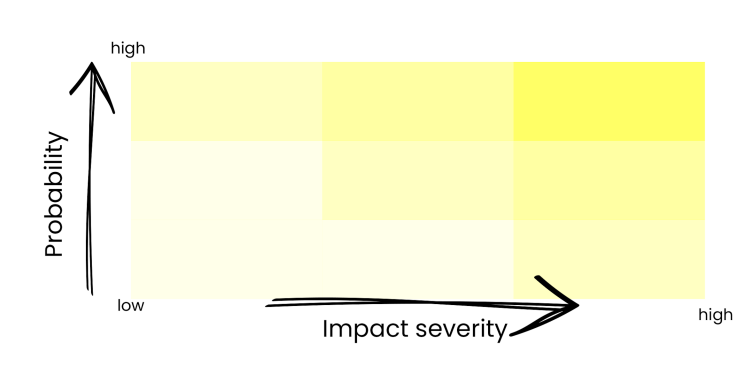
Risk mapping matrix example
Using a risk matrix helps move conversations away from gut feel and toward structured prioritisation. Not all risks are equal, and this step quickly highlights which ones genuinely require action versus those that can be monitored more lightly.

 Step 3: Define mitigation and contingency plans

For all risks that fall in either medium or high probability, or medium to high impact, you should then develop:
  • Mitigation strategies: what you can put in place to reduce the likelihood of the risk occurring (for example, content guardrails, approval workflows, moderation rules or training).
  • Contingency plans: what you will do if the risk does occur, including escalation pathways, response timelines and ownership.
Documenting these plans in advance ensures teams can respond calmly and consistently. It can also help to show you review teams you've already planned for areas of concern. 

Mitigating risk with real examples

Below we’ll walk through three real-life examples of common pharma social media risks, alongside high level, practical plans that teams use to manage them effectively. 
Example 1
Risk: A medical disclaimer could be missed by a patient when viewing a social media asset for an unbranded patient campaign.
Mitigation: During design and approval processes, show your assets in-situ on the social platforms where possible to make it easy to see how the format works and the location of the medical disclaimer in this. Agree on how prominent the medical disclaimer needs to be e.g. how long it needs to be on screen in a video. If using post copy to communicate a disclaimer, watch out for text truncation on post copy which could mean the disclaimer appears below a ‘see more’ button.
Example 2
Risk: There is negative commentary coming through on social media
Mitigation: 
A decision tree and scenario planning prepared and approved ahead of time ensures the community manager who monitors content knows how to manage these comments and escalate if required. Some options available if negative comments do come through include:
  • Removing the comments if they are offensive or rude
  • Banning individuals from commenting if they make these types of comments
  • Turning off comments (see our free sample course on preparing for a two-way dialogue for more information on this).
  • Turning off the paid media spend on a post so it no longer gets visibility. Review the targeting of posts with negative engagement. You could relaunch the post again and tweak the targeting to reach a more positively engaged group. 

Example 3
Risk: We have engaged an influencer and they respond poorly to comments on a paid partnership post
Mitigation:
Prepare a discussion guide before the campaign launches and share it with the influencer at briefing. This should cover how to handle comments and provide pre-approved messaging they can use in their replies.

Need more guidance? 

Risk mapping is just one part of our specialist 45-minute Mitigating Risk mini-course for pharma marketers. The aim of the course is to help you breeze through MLR reviews with an understanding of any of the pitfalls associated with using social media for pharma campaigns - and a practical plan for how you'll avoid them.

The course includes a recommended process for approaching MLR review, an approach for mitigating risk, including real world examples, and a rundown of the potential areas of risk in pharma social media campaigns, with practical mitigation strategies.

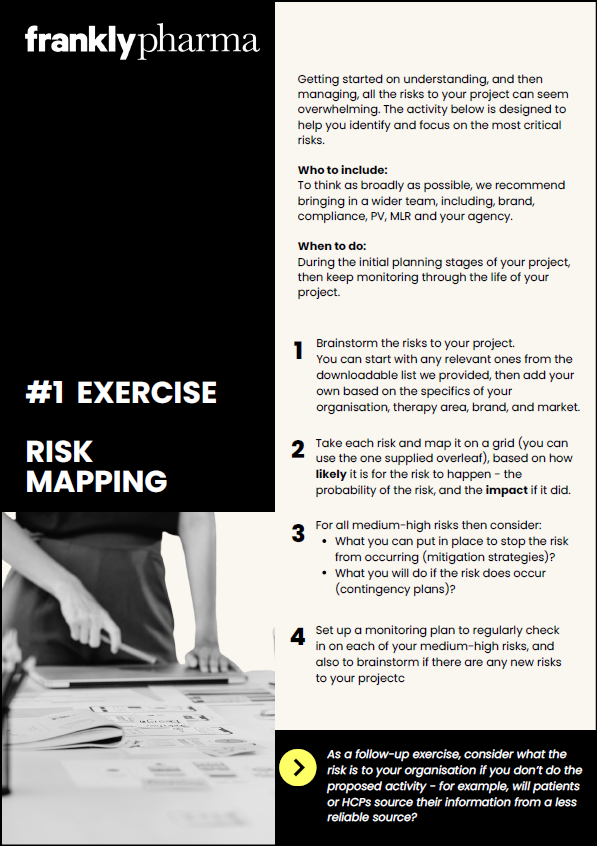
Risk Mapping Activity Worksheet

This worksheet provides a framework for a risk mapping activity to identify and focus on the most critical risks. 
  • This download is featured in our "Mitigating Risk in Pharma Social Media" mini-course. This 45 minute course will help you breeze through your next MLR review with a practical plan for addressing any risks.   

Ready to create brilliant campaigns?

Our specialist courses in social media for pharma offer you the chance to master essential marketing skills with step-by-step guidance in our videos and eBooks, plus plenty of templates and downloads to help you put your newfound learning into action right away.
Created with